

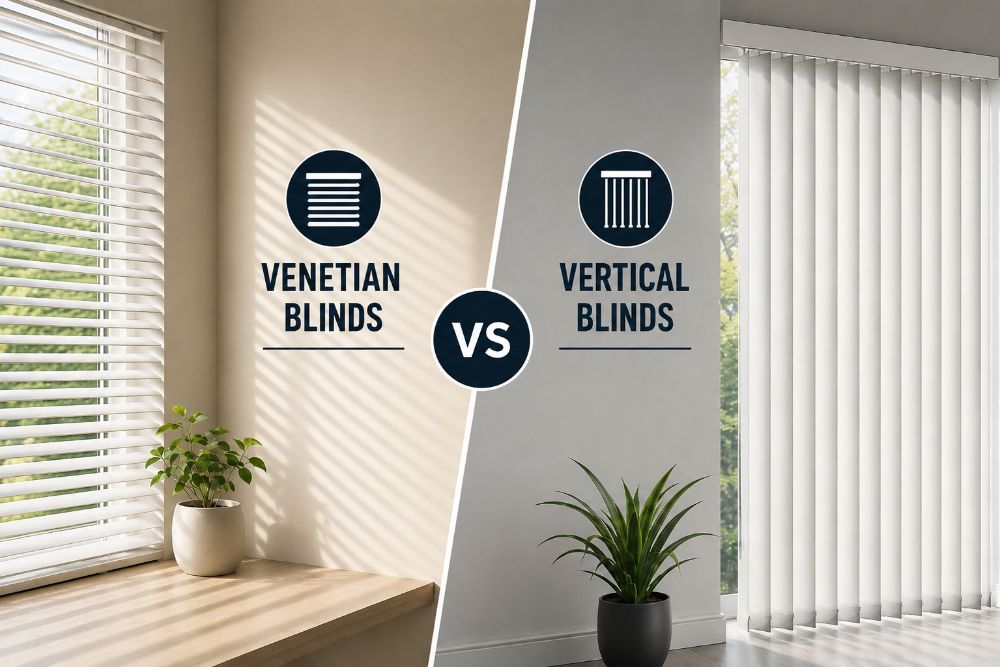
When choosing blinds for your home, two styles often come up first: vertical and Venetian.
If you are comparing vertical blinds in Hull, it usually means you want something practical, neat, and easy to live with. They are a familiar choice for larger windows and glazed doors, but that does not automatically make them the best option for every room.
The real difference between vertical and venetian blinds comes down to how they hang, how they control light, and the kind of finish they bring to a space.
How the two styles work
Vertical blinds have upright slats that hang from a track.
These slats can be turned to manage light and privacy, and the whole blind can usually be drawn to one side. That makes them especially useful for patio doors, wide windows, and rooms where access matters.
Venetian blinds are built with horizontal slats.
These slats tilt to let light in or block it out, and the blind lifts upwards rather than sliding across. This gives them a more structured appearance and often a more detailed level of light control.
If you are still weighing up different options for your home, it can help to read what are the different types of blinds in Hull, UK? before narrowing it down to one style.
The biggest visual difference
The first thing most homeowners notice is the overall look.
Vertical blinds tend to feel simpler and more functional. They suit modern homes, conservatories, offices, and wider glazed areas where a clean finish matters more than decorative detail.
Venetian blinds usually create a sharper and more styled look. Because of their horizontal lines, they often feel more tailored in living rooms, kitchens, and bedrooms. That is one reason venetian blinds in Hull are often chosen by homeowners who want something practical without losing that finished look around the window.
Which one gives better light control?
Both styles let you adjust light, but Venetian blinds usually give you more precision.
Because the slats are smaller and closer together, you can fine-tune how much daylight enters the room. This works well in front-facing rooms where privacy matters but you still want natural light.
Vertical blinds are still effective, especially on larger windows, but the control feels broader rather than finely tuned. They are good for reducing glare and covering a wider area with less fuss.
Which option is better for privacy?
This often depends on the room.
Vertical blinds are a strong option for doors and large windows because they provide full coverage and are easy to adjust during the day. They work well in spaces where people are moving in and out regularly.
Venetian blinds are often preferred in rooms where privacy and appearance matter equally. When tilted properly, they can help reduce visibility from outside while still keeping the room bright.
What about cleaning and maintenance?
This is where many people start to separate style from practicality.
Vertical blinds are often easier to maintain in busy areas because the slats hang down individually and can be simpler to wipe or dust. They can be a sensible choice for homes where low maintenance is high on the list.
Venetian blinds can collect dust more quickly across each horizontal slat. They are not difficult to clean, but they do need more regular attention to keep them looking fresh.
That is why it is worth thinking about how the blind will work in real life, not just how it looks on the day it is fitted. A helpful related read here is what happens if you pick the wrong blinds in Hull?
Which one suits large windows better?
Vertical blinds usually come out ahead here.
Their design naturally suits wider openings, taller windows, and patio doors. They are often the more practical choice where access and coverage matter just as much as appearance.
Venetian blinds are more commonly used on standard-sized windows where their shape and detailing can be appreciated more easily.
Are there any important UK points to keep in mind?
For most homes, the key compliance point is blind safety.
The UK government states that new blinds with looped cords must have child safety devices fitted at the point of manufacture or sold with them.
If your property in Hull is listed, internal alterations may also need listed building consent, depending on the nature of the work.
Which style is the better choice?
There is no single answer that suits every home.
Vertical blinds are often the better fit for wide windows, doors, and rooms where practicality comes first. Venetian blinds are often better for standard windows, sharper styling, and more precise light control.
The best choice usually comes from looking at the room properly rather than choosing by trend alone. If cost is also part of your decision, it may be worth reading how much do fitted blinds cost in Hull, UK? so you can compare style with budget more realistically.
Need help deciding?
Both styles can work beautifully in the right setting, but they do not serve every room in the same way.
If you are unsure whether vertical or Venetian blinds would suit your home better, get in touch with Ideal Blinds for straightforward advice based on your windows, your space, and how you want the room to feel.